
Independent analysis of long-term financial promises
Understand the value behind the promise.
Long-term financial products ask you to commit resources today for value that may not be fully visible for years. Longevity Standard helps bring more of that into view before you rely on it.
What you commit
Where value may come from
What reduces or constrains it
What ultimately reaches you
Independent by design
Independent by design.
Independent analysis focused on the people and institutions relying on the product.
Our economics are tied to doing the analysis — not to which product is chosen, how much is purchased, or whether a transaction takes place.
Our role is to examine the product, the evidence, and the conditions that determine what value may ultimately be delivered.
Independent
Tied to doing the analysis.
Evidence-led
Important findings trace back to applicable source material.
Focused on delivery
We examine what you commit, what you may receive, what can change, and what can interfere along the way.
You give up resources today. What exactly are you getting in return — and what has to happen for that value to reach you later?
Price and headline features are visible at purchase. Long-term value often is not.
LS Review
A closer look at what you are actually being offered.
LS Review starts with a real product and builds outward — from the materials in front of you to independent product, company, and source research.
The result is a clearer view of the terms, the evidence behind them, and the conditions that matter.
Identify the product
Establish the evidence
Examine what is being offered
LS Review — product screen
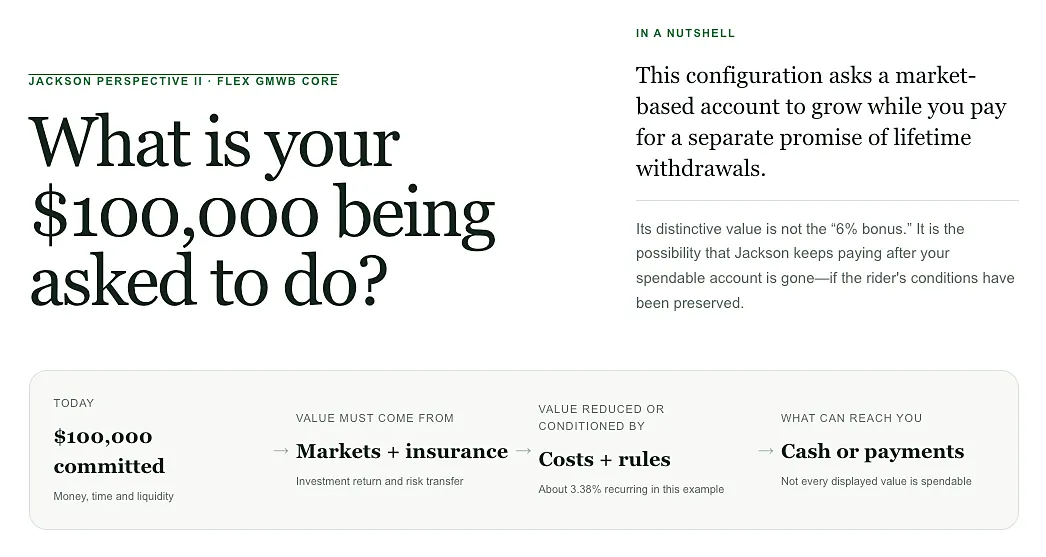
Fig. 01
The same four-step pathway, inside a real Review
The method
Start with the evidence. Follow the value.
Establish what applies.

Contracts

Forms

Riders

Company records

Transaction-specific materials
These are not interchangeable. The first job is determining what evidence actually applies to the product in front of you.
Separate certainty from possibility.
Guaranteed
Changeable
Conditional
Unresolved
Different claims deserve different levels of confidence.
Follow value from commitment to delivery.
What do you give up?
Where can value come from?
What absorbs or constrains it?
What can ultimately reach you?
What If
What if the future looks different?
Long-term financial products are experienced in conditions we cannot know in advance. What If lets you change one condition and see why it could matter.
Start with a question. Change one thing. See what it could mean.
Inside the Review
See what matters more clearly.
01
What is promised
What the product actually commits to provide.
02
What can change
Rates, settings, conditions, and discretion that may vary.
03
Costs and access
What reduces value or limits when money can be reached.
04
Conditions of delivery
What must happen before particular benefits or values are available.
05
Who stands behind it
The institution responsible for delivering the obligation.
And what the evidence can actually establish.
Some things are known. Some can change. Some depend on the future. Some remain unresolved.
Cost is rarely one number.
LS Review — product screen, detail
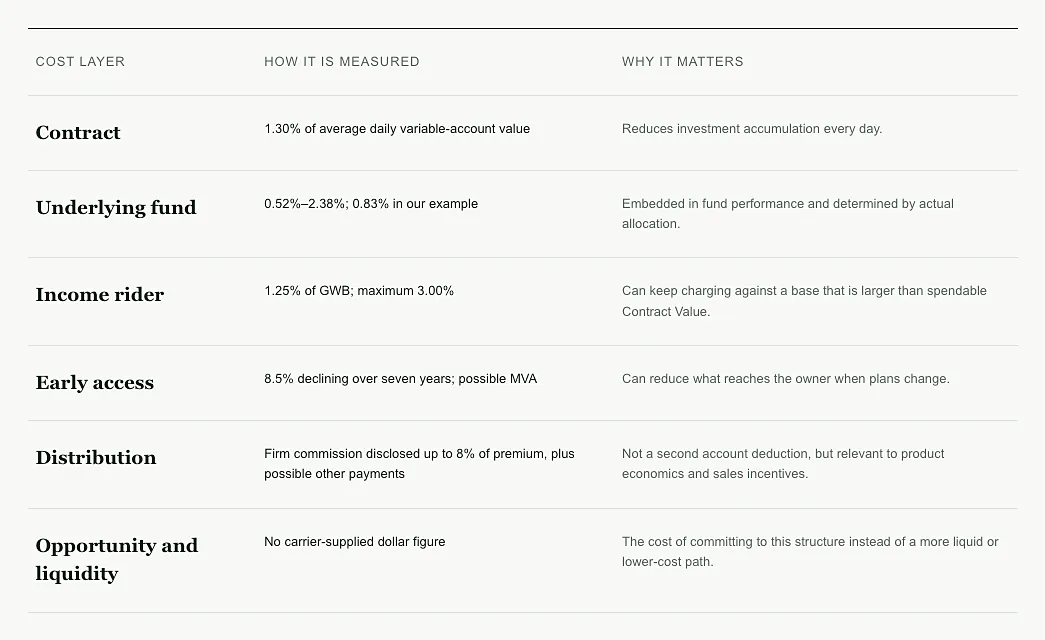
Fig. 02
Cost layers — how each is measured, and why it matters
Who it’s for
One discipline. Two ways to use it.
For Individuals
Understand a product before you rely on it.
Get an independent examination of the terms, evidence, costs, conditions, and uncertainties surrounding a long-term financial product.
For Institutions
Understand what you are offering. Help the people relying on it understand it too.
Use independent buyer-side diligence to support evaluation, explanation, and ongoing understanding of long-term financial products.
Evidence
Say what the evidence supports — and show where it stops.
A long-term obligation is only as understandable as the evidence supporting it — and the institution responsible for delivering it.
LS Review — product screen, detail
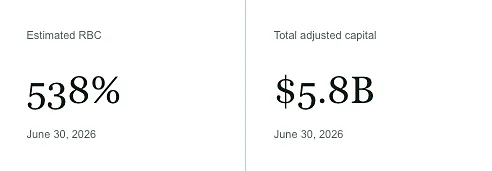
Fig. 03
Dated issuer capital — a fact, not a conclusion
We can establish
Contractual guarantees
Current product terms
Applicable forms and riders
Current issuer information
Documented costs and restrictions
We cannot establish from the product alone
—
Future rates
—
Future inflation
—
Future markets
—
Future behavior
—
Outcomes that depend on conditions not yet known
Know more before you rely on it.
Tell us the product you are considering, or share the materials you received.